|
|
|
|
|
| Over the years, the list of registered orchid hybrids maintained by the Royal
Horticultural Society has grown to encompass seven volumes with more than
100,000 total entries. Acquiring these books, if you can find them, would cost
many hundreds of dollars. Similarly, there have been well over 50,000 awards
granted to orchid species and hybrids in the last 27 years since the Awards
Quarterly magazine was first published, with more than 1500 new awards being
added each year. Sifting through these publications to find information about
particular hybrids can be a daunting and time consuming task. The Wildcatt Orchids database puts all this information at your finger-tips at a fraction of what it would cost to buy all of these publications. Better yet, with Wildcatt there's no thumbing through mountains of books and magazines to find the information you want. Just type the first few letters of the hybrid or species you are interested in and its information is immediately displayed. Further specialized parts of Wildcatt allow you to quickly generate genealogies back to species, create progeny lists for any number of generations, find out if a cross has been registered, and more! |

|
Wildcatt Orchids is a full featured database program that incorporates all the data contained in Sander's List of Orchid Hybrids as well as Awards Quarterly data from the present back through 1970 into a powerful tool that allows you to sift and analyze information pertinent to awardable orchids in your collection or to crosses in your breeding program. With Wildcatt Orchids you will be able to:
|
| Buried within the pages of Sander's List of Orchid Hybrids and Awards
Quarterly lies a wealth of information invaluable to breeders of orchids and
collectors alike. Using these two publications, breeders can discover what the
breeding trends are in his particular area of interest, and what breeding lines
are particularly successful. Similarly, the collector interested in obtaining
and exhibiting awardable plants can determine which new crosses are potential
winners, valuable information when choosing which plants to buy. Accessing this information, however, is not always simple. Digging through all seven volumes of Sander's to trace a genealogy can be a daunting and time consuming task. To trace just one plant in this manner can take hours. To cross reference this data with the awards data contained in Awards Quarterly in any meaningful way can quickly become a job of mammoth proportions. Add to this the fact that the early volumes of Sander's books are virtually unavailable, and this "wealth" of information truly becomes a buried treasure. Now that the personal computer has become commonplace and affordable, the technology is here to put all this data at your fingertips. Wildcatt Orchids is the most comprehensive orchid database available. It incorporates all the data contained in Sander's, as well as awards data, up to March 2007 and going back to 1970, volume 1 of the Awards Quarterly publication, combining these facts into a full featured database program. This program allows you not only to access data about individual orchids, it lets you explore entire breeding lines. |
| Wildcatt can produce the genealogy of any hybrid in seconds; it can evaluate
the progeny of a species or hybrid, find the crosses registered by a breeder, or
find the AOS awards of a selected hybrid. Wildcatt can do much more than list
data; it can extract information continued in the Sander's registrations
and the Awards Quarterly. Have you fallen in love with long petaled multi-floral Paph crosses? Or with these beauties crossed with the white brachypetalum hybrids? You can build a list of all registered multifloral hybrids and extract those that have this type of breeding done. Check your list against the awards data to see what has been awarded. In minutes you can evaluate what the breeder has done referenced against what has won awards.
|
|
|
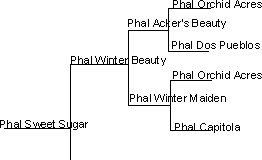
Use the powerful genealogy tree feature to explore the lineage of an orchid. A pie chart of the species involved in the plant or any of its ancestors is only the push of a button away. Use this information in combination with the progeny search and graph features to compare your plant to the orchids that have been used most successfully in breeding. |
| Wondering where to get that white Paph judged? Wildcatt will generate a graph
of the number of awards versus judging center to find out where most awards are
granted to your type of plant. List petal dimensions and description, or graph
petal size as a function of points awarded. Is it your turn to prepare a program for your local Orchid Society meeting? Any of the lists, graphs or trees that can be generated can also be printed for a great presentation. Progeny and tree lists can also be printed to a text file so that you can bring them into your favorite word processor, or cut and paste them into e-mail. Wildcatt can also simplify the registration process when your club hosts a show. The quick search feature lets you quickly look up the name of any registered cross or find the parents of any registered hybrid. And with updates available every six months, Wildcatt is the most current database around! |
| I began growing orchids in 1960 something, and my first orchid was the
proverbial Cattleya. Next came the Dendrobium and Epidendrum and Oncidium. I
truly believe this is the way most people begin. As the years progressed and the orchids, either barely existed or died, my tastes began to change. Now in the 1990's I have finally found the orchids that love the growing conditions I provide and they are thriving like never before. The Phalaenopsis is my orchid of choice, although I do have some other species and hybrids. The plants I order are thoroughly researched and I have purchased every type of reference book available; i.e. Sanders, Listings of Hybrid Registrations, etc., etc... In the OLD days, I would see an advertisement of plants I was considering buying and the books and catalogs would begin to cover the table, floor, davenport and my lap. Most of the time it is easy to look up the parents of a longtime hybrid. But, then comes the complicated part. If you are fortunate enough to find the parents of a plant listed in the ad,
the next I would like to point out that, quite often, I had even forgotten which hybrid I was initially investigating . Needless to say, this time-consuming, messy job was becoming unbearable. If you want to produce hybrids yourself, it is also important to do your research and my way of doing it was becoming impossible. I finally bought a computer and my first software purchase was the 'WILDCATT' program. What a trip to heaven that was the first time I used it!!!! Now, all I have to do is make a few keystrokes and I have a complete family history in a matter of seconds. Another keystroke prints it out. Yet, another keystroke and I have the species breakdown of the plant that I am researching. The "Awards Quarterly" information is also available. This program is invaluable, and everyone who breeds or buys orchids should have this tool in their orchid library. Now, I don't even have to think about spending another $100.00 or so for a new Sanders book, that is outdated the day it is printed. Thank you for producing the most reasonably-priced and complete orchid guide available. |
Windows 3.1x/9x/NT/XP or higher
386 or higher processor
16 meg RAM recommended
70 Meg free space on hard drive required to run program
| No Mac version of Wildcatt is planned at this time. Mac users are able to run Wildcatt if they install PC emulation software such as Virtual PC on their machine. A second alternative is to install a PC card in the Mac. |
|
Send mail to
orchids@WildcattData.com with
questions or comments about this web site.
|